Most leaders I work with understand that AI can improve productivity. Fewer have a clear strategy for using AI to create genuinely new value in their products and services. They know they should be doing more than automating workflows, but when it comes to enhancing what customers actually experience, the conversation stalls. The question shifts from "how do we work faster?" to "how do we make what we offer worth more?" and that second question is harder to answer without a structured approach.
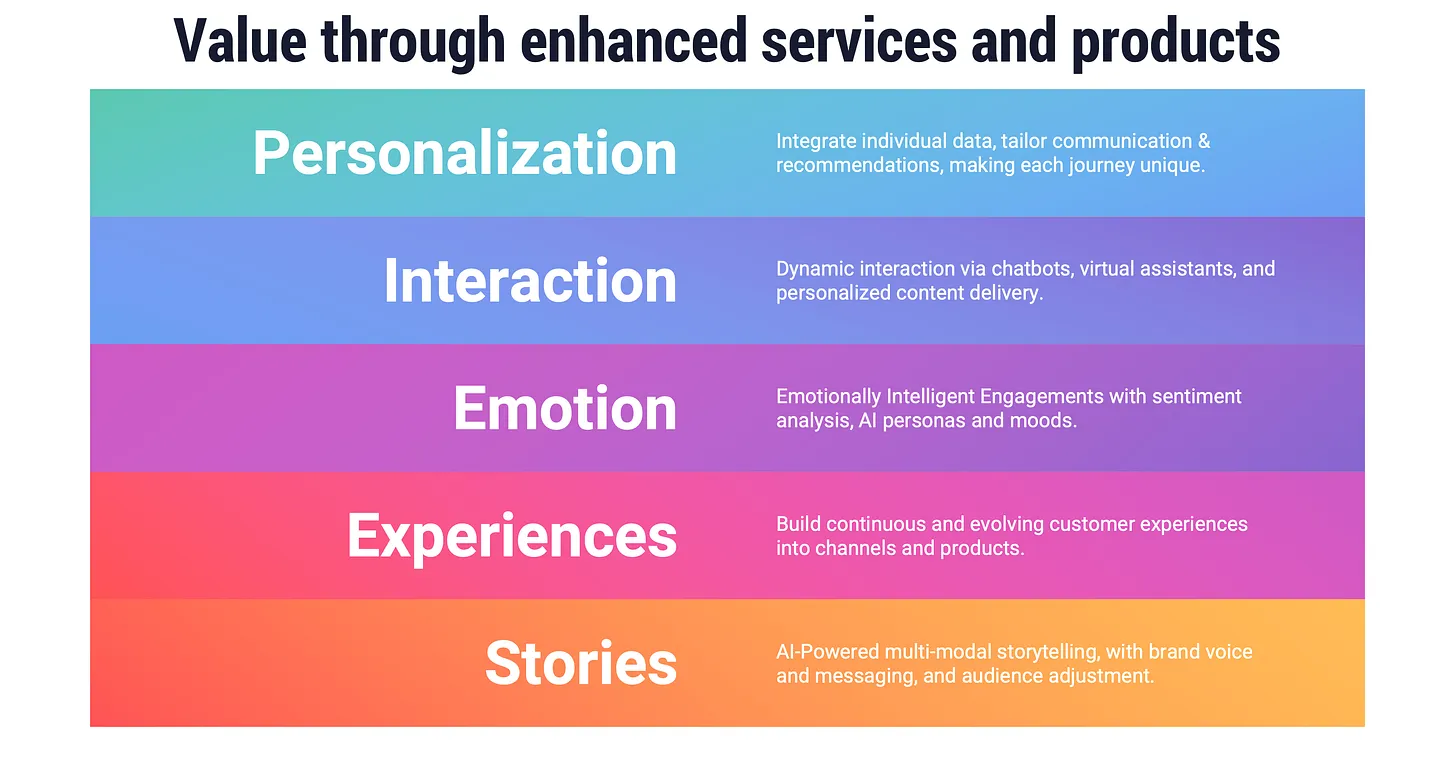
Back in issue #1, I introduced the three-bucket framework for AI strategy: Productivity, Creating New Value, and Disruption. The "Creating New Value" bucket is where many organizations have the largest untapped opportunity, and the least clarity. To address this, I use a framework I call PIEES, which breaks down value creation into five distinct dimensions: Personalization, Interaction, Emotion, Experiences, and Stories.
Personalization
Personalization uses individual data to tailor communication and recommendations so that no two customers receive the same experience. This goes well beyond inserting a first name into an email. Amazon attributes 35% of its purchases to AI-driven personalized recommendations. Fashion retailer boohooMAN achieved a 25x ROI on personalized birthday SMS campaigns. When done well, personalization makes customers feel that a product was built specifically for them, and that feeling translates directly into conversion and loyalty.
Interaction
Interaction is about enabling dynamic, two-way engagement through conversational AI and responsive content delivery. The shift is from static interfaces to conversational ones. Bank of America's virtual assistant Erica has handled over 2 billion interactions, with 56 million monthly engagements and a 98% resolution rate in an average of 44 seconds. Sephora's AI chatbot, combined with AR try-on, drove a 30% increase in engagement and a 15% lift in sales. These are not gimmicks. They are a fundamental change in how customers interact with products: from browsing to dialogue.
Emotion
Emotion means building emotionally intelligent engagements through sentiment analysis and AI personas that respond to how users feel, to what they actually need in the moment. This dimension is the least mature of the five, but it is growing faster than any other. The sentiment analysis market is projected to reach $6.1 billion by 2026, growing at an 18.9% CAGR. Companies using sentiment analysis are 2.4 times more likely to exceed their customer satisfaction goals. As I discussed in this issue's opening section on hybrid teams, emotion is moving from a soft consideration to a core design requirement. The organizations that figure out how to make AI interactions feel human, without pretending to be human, will have a significant competitive advantage.
Experiences
Experiences is the dimension of building continuous, evolving customer journeys that learn and adapt over time, rather than treating each interaction as an isolated touchpoint. Netflix saves an estimated $1 billion per year through personalization that reduces churn, but the deeper value is not in any single recommendation. It is in the accumulated experience of a platform that increasingly understands what you want before you search for it. This is a shift from designing touchpoints to designing identity-driven journeys, where the product's understanding of you deepens with every use.
Stories
Stories is about using AI-powered, multi-modal storytelling to deliver brand voice and content tailored to specific audiences. Humans love stories and have done so for millennia, and AI's ability to generate and adapt narrative across multiple media formats (text, audio, image, video) can tap into that. This dimension goes beyond content creation: it is about making every customer interaction part of a coherent narrative that reinforces what you stand for.
The compounding power of PIEES
The real power of PIEES is in how the dimensions compound. Consider Spotify. Its Discover Weekly and the recommendation engine deliver deep Personalization. The Prompted Playlists tool, launched in January 2026, lets users describe what they want in natural language and generates playlists from their listening history. That's Interaction meeting Personalization. The platform's algorithms increasingly respond to mood and context (Emotion), while the continuous relationship with each listener deepens over time (Experiences). And Spotify Wrapped transforms a year of listening data into an emotionally resonant personal narrative that users share across social media: Stories. Wrapped was so effective that Duolingo and Reddit both created their own year-in-review experiences, and several other platforms followed. One company, all five dimensions working together.
Your action step
Take the PIEES framework and score your product or service on each dimension, from 1 (not using AI at all) to 5 (AI-driven and deeply integrated). Identify your weakest dimension. Then design one AI enhancement that would move that score up by a single point. Many teams I work with find that their Personalization and Interaction scores are reasonable, but Emotion and Experiences tend to hold the biggest untapped potential.
In future issues, I will go deeper into individual PIEES dimensions, starting with the ones that are hardest to get right. The frameworks and examples will get more specific as we move from strategy to implementation. For now, the most important step is honest assessment: where does your product actually stand on each of these five dimensions, and which one would create the most value if you improved it?
For some reflection and inspiration, watch Michael Ronen's TEDx talk "Artificial Intelligence Can Help Grow Emotional Intelligence." Ronen is an Israeli theater director turned tech founder who started by having Israeli and Palestinian actors play each other's roles, and discovered that roleplay transforms understanding. He now applies the same principle to business: AI can roleplay your customer at scale, simulating journeys with up to 85% accuracy. Lufthansa, for example, built a customer insight hub where design teams simulate traveler journeys before launch. His concept of the "play economy," using play and simulations to truly understand your customer, maps directly to the Emotion and Experiences dimensions of PIEES. As Ronen puts it: "AI can help us grow our emotional intelligence."