AI has made it much cheaper to build a working demo, and I think more and more teams will show customers a working demo early on, instead of mockups and specification documents.
But what if we could handle their requests during the call itself? Today, when a customer says that something important to them is missing, it usually goes into the next version of the demo, and the customer may see it a couple of weeks later, if at all. It is now becoming possible to make that fix during the call itself, while the customer is still there.
What a live demo assistant could do
So what would that look like? Imagine an assistant that listens to the call together with the seller. After a few minutes it has picked up what the customer wants to see and is missing from the demo, and it ranks those gaps by how often they came up and how much weight the customer gave them. It starts building the top three in the background, on simulated data, and lets the seller know what it is working on. The seller decides which one to show, and when.
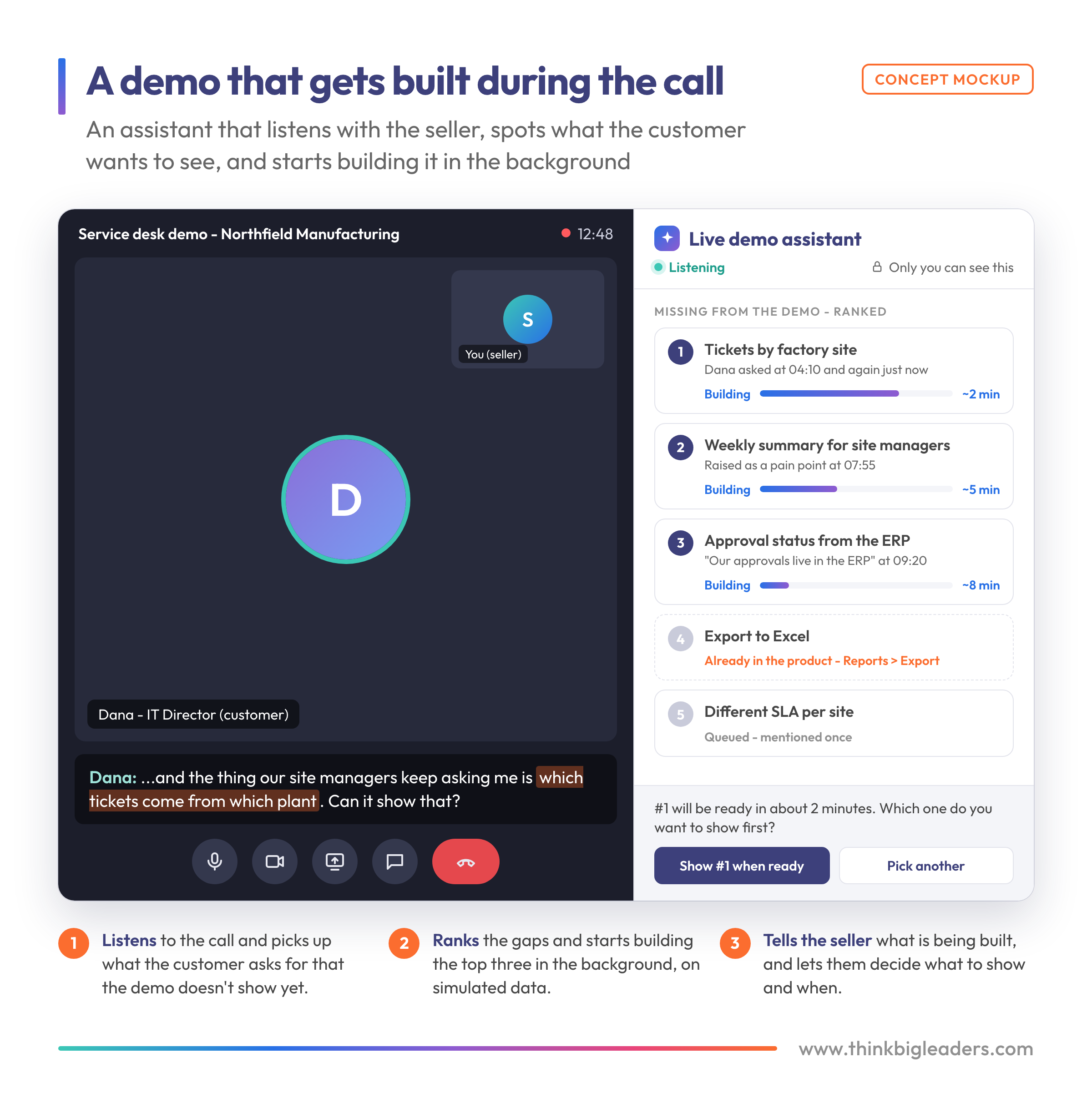
In the concept mockup above, the assistant has also noticed that one of the requests is already in the product, so the seller can simply show where it is instead of building it again.
The feedback is the biggest benefit
I think the biggest benefit is the feedback. When customers see something they asked for earlier in the same call, you get their reaction to it right away, and you can see whether they are excited about it. That reaction, and the next thing they ask for, goes back into the list. After the call, the ranked list and the customer's reactions can go to the product team as evidence of what customers actually want to see.
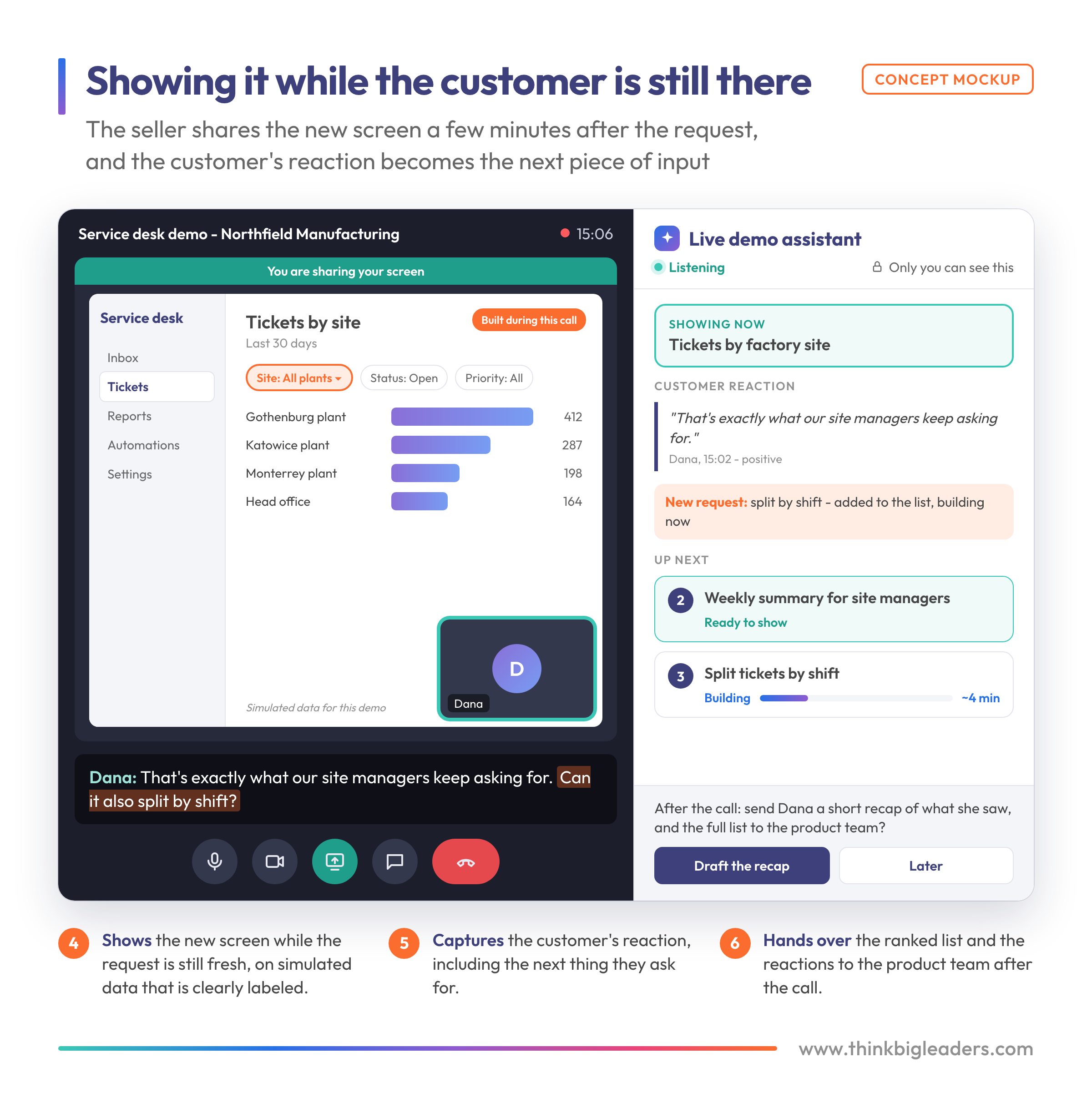
This is not only for sales teams. A product team showing a prototype to internal stakeholders could work the same way.
Where the idea came from
Two podcast episodes I listened to recently got me thinking about this.
On the Product Builder podcast (in Hebrew), Ran Ribenzaft, the co-founder and CTO of Harmony, talked about what he calls "demo-market fit" - adding what prospects asked for to the demo before the next call. Some of his prospects even asked for access afterwards, because they did not realize it was not a real product yet. In his description, the demo is something he can shape however he wants, and it gets better from call to call: when a prospect says something is not supported, the next prospect who asks already sees it working. When the original prospect gets a follow-up two weeks later, it is "remember the feature you wanted? Here, we added it." He also said he no longer argues with prospects about edge cases, and adds what they ask for instead. (The episode is in Hebrew, so these are my translations and paraphrases, not his English wording.)
And on Aakash Gupta's Growth Podcast, Wade Foster (the CEO and co-founder of Zapier) said he has seen some people at Zapier feed a live transcript into a coding agent and fix things during the conversation, and called it "starting to look pretty transformative." He described why it works like this:
"you're literally just taking like what the person is telling you and you're literally feeding it right back to them. And so when they see it come up, they're like, oh, great. That's amazing."
He also said he does not think it is "a tactic that's like widely used yet". The idea in this post takes that tactic one step further, from a person feeding the transcript into an agent by hand to an assistant that does the listening and the building while the seller keeps the conversation going.
Go deeper
If you want to dive deeper, watch that episode. Wade grades Aakash's product work live on Zapier's AI fluency rubric, which runs from unacceptable through capable and adoptive to transformative. He explains why he sees a working prototype as worth much more than a document ("seeing is believing", in his words), and how he would use AI to go through sales call recordings and support tickets to find customer evidence. You can also see the moment where Aakash shows simulated sales call data that he added during the conversation, after hearing Wade ask for it.
If you have not built a working demo with AI yet, I wrote about going from Working Backwards to a working prototype in a week, and about three ways executives create business value with vibe coding.
Your action step
Take the recording or the notes from your last demo or stakeholder review. Write down everything the customer asked to see that the demo did not show, and rank the list by how often each request came up and how much weight they gave it. Then pick the top item, build it on clearly labeled simulated data before your next call, and watch the reaction when you show it.
Would you use something like this in your sales calls, or in your demos to internal stakeholders? I would like to hear about it.
If you want to explore how AI prototyping can change the way your teams sell and test new ideas, that is the kind of work I take on in AI strategy advisory engagements and in sessions as an AI keynote speaker and workshop facilitator.