More and more of the requests I get from companies are about transformation, and about the role of managers in it. Many of them come down to a practical question: what should a manager do when their team goes through an AI transformation?
I have been working on an answer that combines two frameworks. The first is my framework for business value with AI, which I introduced in the very first issue of this newsletter. The second is adaptive leadership.
What adaptive leadership asks you to do first
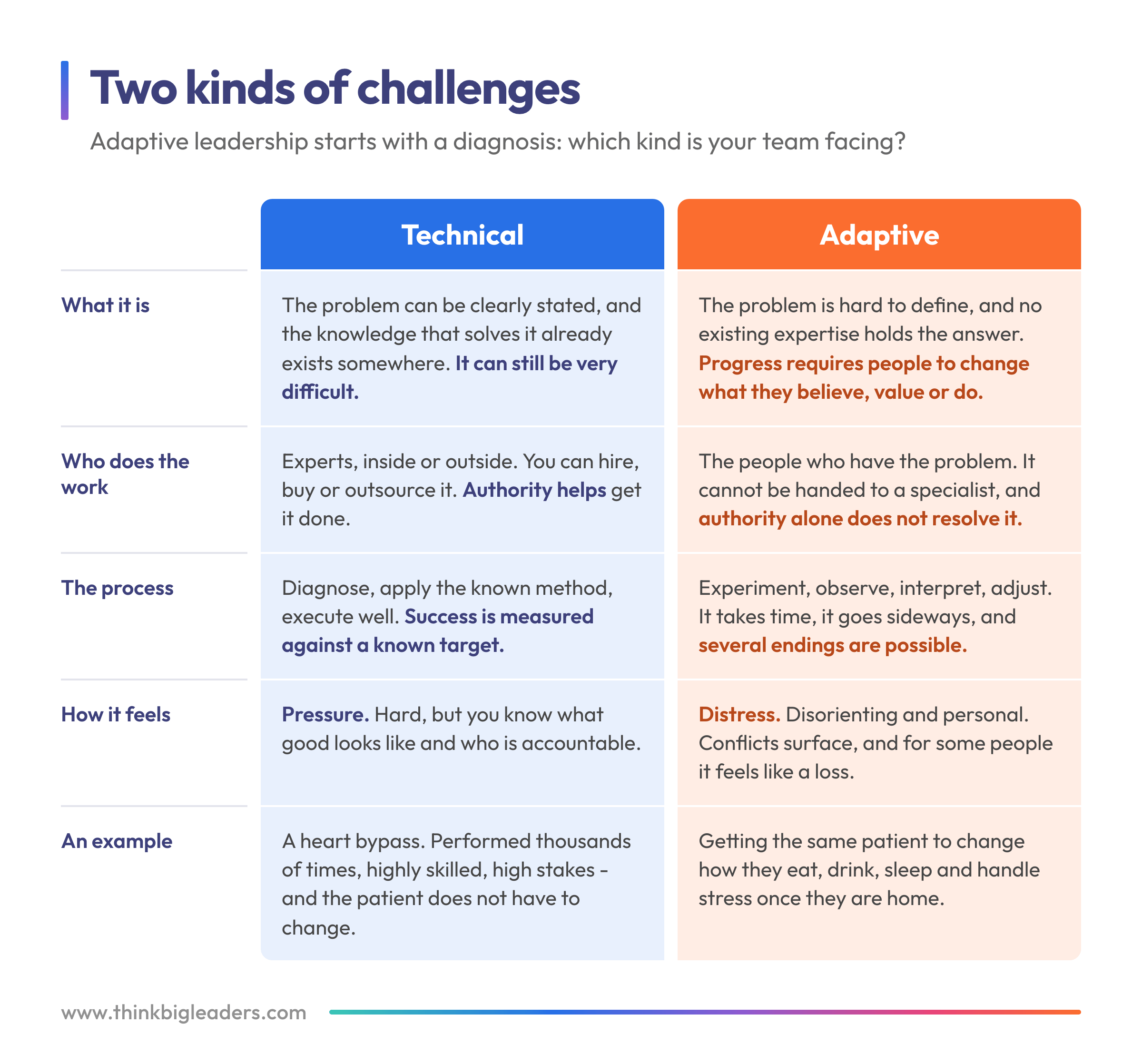
Adaptive leadership was developed in the 1990s by Ronald Heifetz and his colleagues at the Harvard Kennedy School, and I think parts of it are becoming very relevant again in the age of AI. It focuses on leadership as a practice and on what a manager actually does. The first thing this framework asks is to diagnose which kind of challenge the team is facing - a technical one or an adaptive one.
Technical challenges
The term technical can be a bit misleading, because it is easily confused with technology. It can also be interpreted as an easy problem, while in fact a technical problem can be very difficult, but in a different way. What makes it "technical" is that the problem is clear, and the knowledge that solves it already exists somewhere.
When I was a training manager at Teva Pharmaceuticals, we had one year to get a new factory ready for its FDA approval. That included training and certifying a few hundred employees. It was a big project across several departments, but we knew what we needed to do to pass, and when we didn't know something, we could bring in experts from outside.
Adaptive challenges
An adaptive challenge is different. Imagine a medical device factory facing a new regulation for approving products that have AI built into them. Nobody has done that before and there is no best practice yet, so there are no experts to call in. The people involved will need to run experiments and learn from the ones that fail. They will also need to let go of some of the expertise they have relied on until now.
Why the diagnosis matters
If you force technical ways of working on an adaptive challenge, you are likely to set everyone up for failure and frustration. Technical challenges can be solved by exercising authority, the formal authority of a manager or the professional authority of an expert, but authority alone will not resolve an adaptive challenge. If you want to lead that kind of change, you need to understand what people are afraid of losing, and experiment yourself together with your team.
The three paths to business value with AI
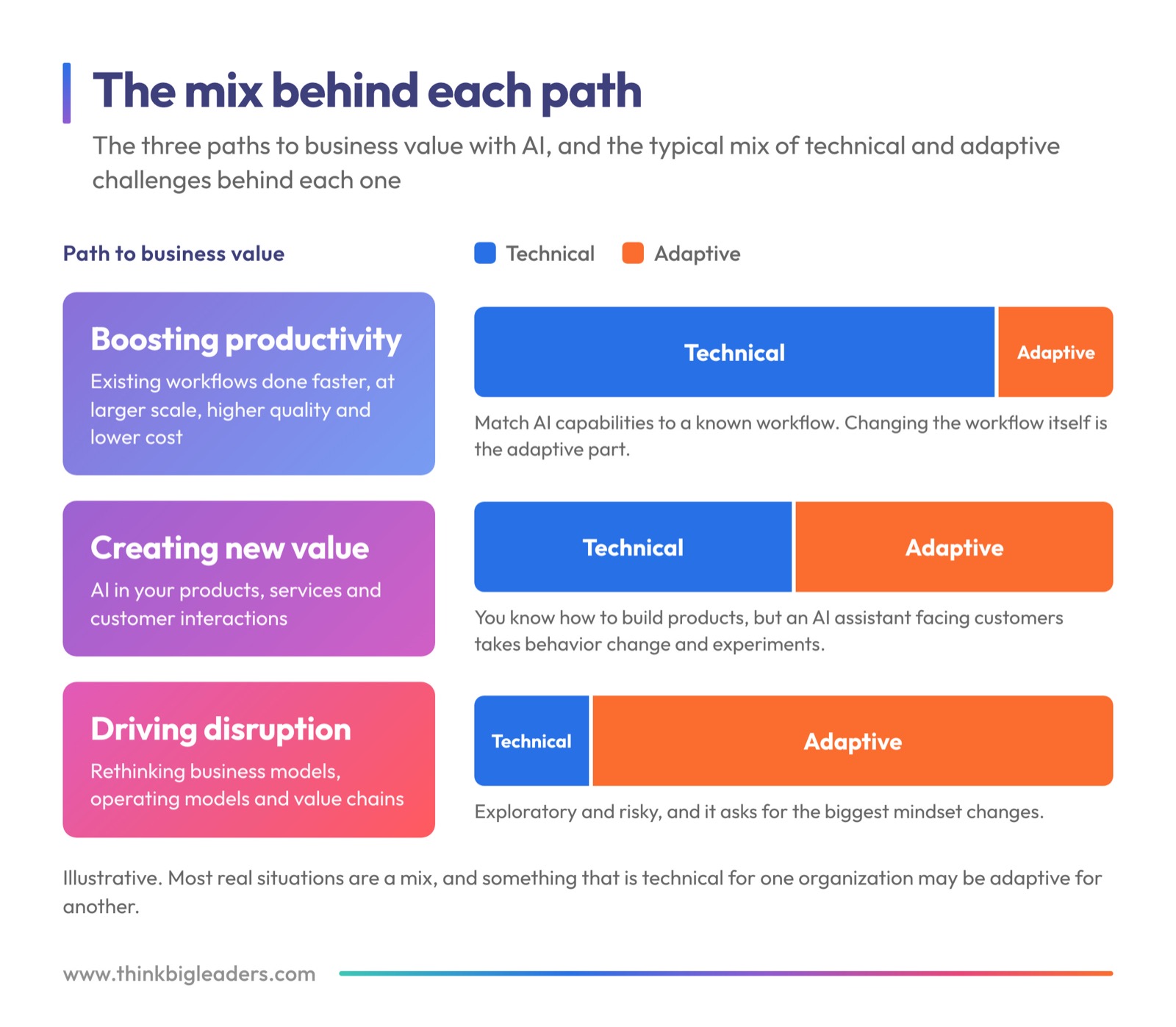
So how does this connect to business value with AI? I think each of the three paths tends to come with a different mix of the two.
Boosting productivity usually starts out as a technical problem: you go through an existing workflow step by step and match AI capabilities to it. It is also an opportunity to ask whether the workflow itself should change, and that part is adaptive.
Creating new value, which means putting AI into your products and into the way you interact with customers, is more of a mix. We still build products in ways we already know, but letting an AI assistant answer your customers' questions is likely to require behavior change (from your team as well as your customers), and some failed experiments along the way.
Driving disruption, which is about rethinking operating models, business models and value chains, is much more exploratory, and it demands bigger mindset changes. It leans strongly toward the adaptive side.
From adaptive to technical, and back again
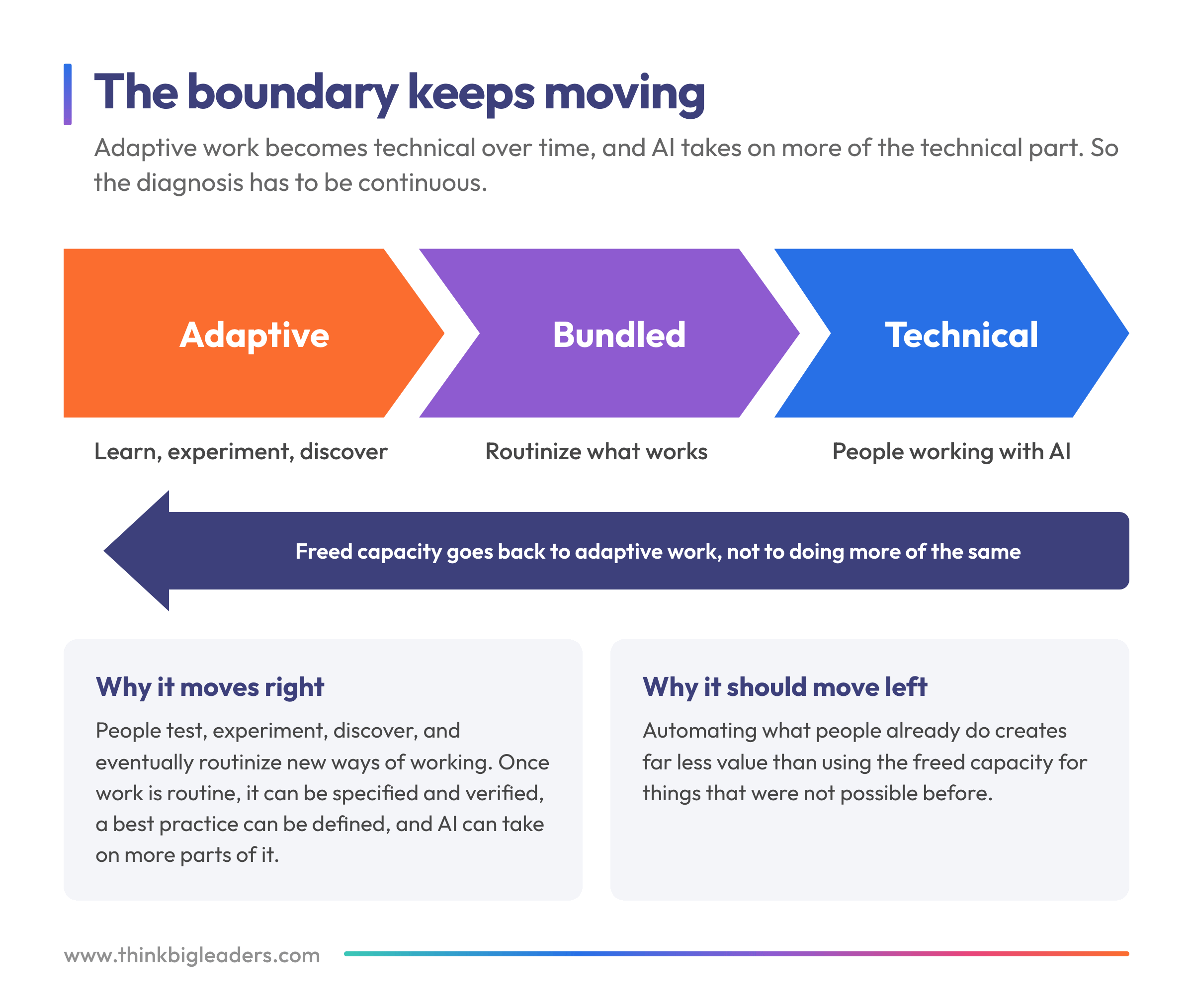
The concept of adaptive leadership comes from biological evolution: once a species has adapted to a new environment, what used to be an adaptive challenge becomes a technical one. Something similar happens in teams and organizations. People experiment until they find what works, and then turn it into routine. Once a task is routine and relies on things AI does well, AI can take on more parts of it. People also need some stability, so as a manager you will naturally try to push things toward the technical side and not have the team living in perpetual chaos and experimentation.
As AI keeps taking on more of that technical work, the capacity it frees should be directed back to the adaptive side - to new behaviors, and to opportunities to think bigger that were not possible before - rather than to doing more of the same. This is also why the diagnosis needs to be continuous. Every time something moves to the technical side, you should ask again what your team's next adaptive challenge is.
What a manager can do on each path
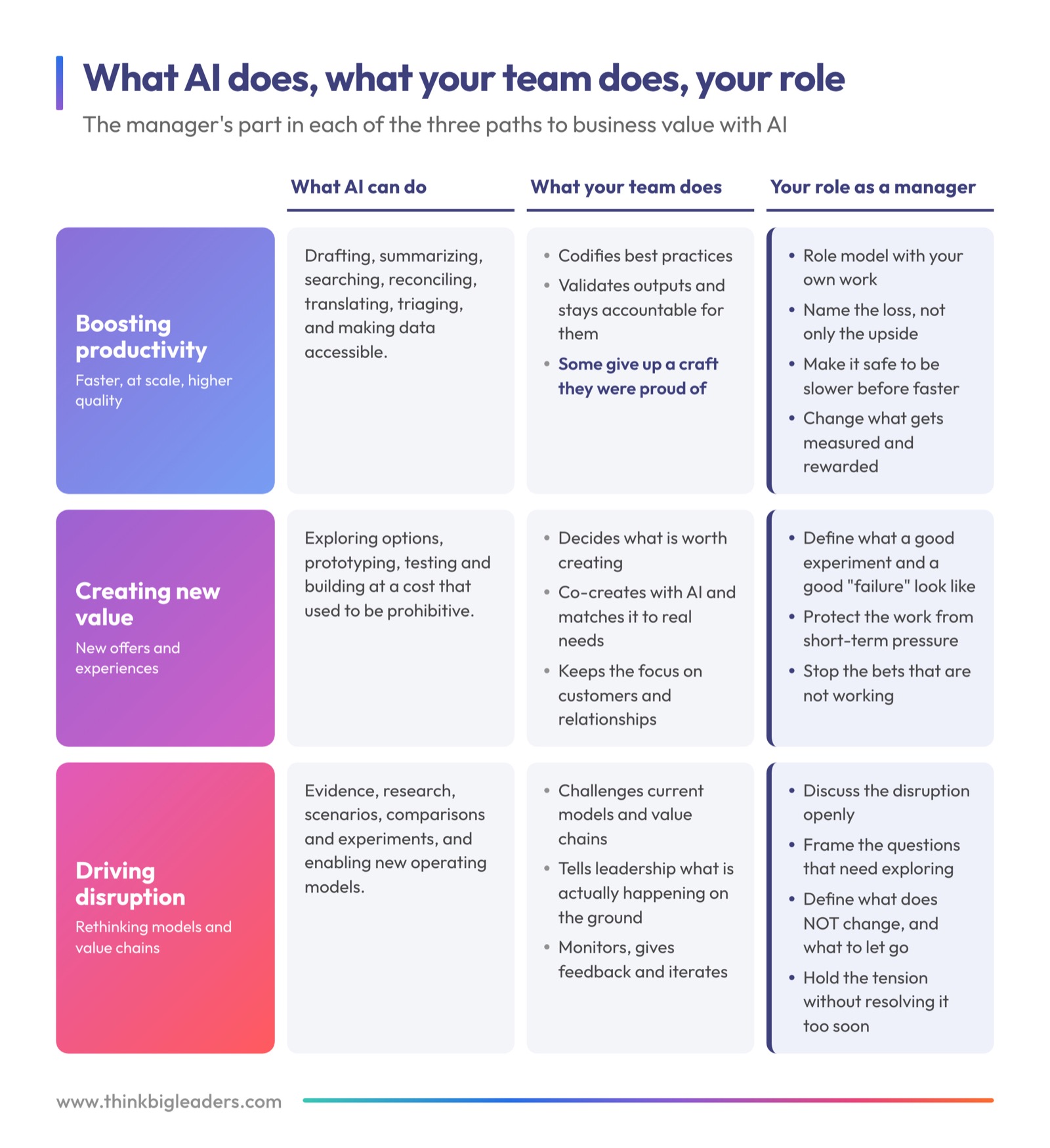
For boosting productivity, ask your team to look for five opportunities where AI could help in one of the processes you run today. Some people may have to give up a craft they were proud of, so acknowledge that loss openly when you talk about the upside.
Creating new value and driving disruption require moving further onto the adaptive side, so your role there is mostly about encouraging experiments and supporting the team. The team decides what is worth creating and keeps the focus on customers, and it should be able to tell leadership what is happening on the ground. Your job is to define what a good experiment and a good "failure" look like, and to stop the bets that are not working. When the conversation turns to disruption, you should discuss it openly and be clear about what does not change.
In the previous issue I wrote about building one AI frontier team, with a clear outcome to own and an explicit permission to fail.
Managers have their own feelings about AI
Keep in mind that managers have their own feelings about AI transformation too, and for many of them it can feel like a threat. If you want your team to talk openly about what worries them, say it out loud yourself first.
You also do not need to wait for a company-wide AI strategy for any of this. You can start within your own area of influence, with what your team is facing right now.
Go deeper
If you want to dive deeper, watch my conversation with Ondrej Papanek on his podcast, Business Transformation Journey. We talked about why AI has become a leadership topic as much as a technology one, and how the role of middle managers is changing. We also talked about why you should simplify a process before you try to automate it.
The other half of this issue is about AI agent design patterns: how people hand work over to an agent, stay in the loop while it runs, and check what it actually did.
Your action step
Write your team's current AI initiatives on one page, and mark each one as technical or adaptive. For the technical ones, write down who already has the knowledge to solve them. For the adaptive ones, write down what people may be afraid of losing, and what a good experiment would look like.
Then think back: have you seen a technical fix applied to an adaptive challenge? What happened? I would like to hear about it.
If you are leading a team through an AI transformation and want to work out which of your challenges are technical and which are adaptive, that is the kind of question I take on in AI strategy advisory engagements and in sessions as an AI keynote speaker and workshop facilitator.